- BIST10011,618-0.88%
- USD49.45+0.05%
- EUR55.62+0.37%
- GOLD4,188.80+0.18%
- INTEREST37.00%-1.00
- BITCOIN82,453+0.54%
- October 19, 202617°
- BIST10011,618-0.88%
- USD49.45+0.05%
- EUR55.62+0.37%
- GOLD4,188.80+0.18%
- INTEREST37.00%-1.00
- BITCOIN82,453+0.54%
- October 19, 202617°
Irish PM Martin says international community has failed on Palestine
Irish Prime Minister Micheál Martin said the world would be ashamed when the full truth about what happened in Gaza emerged at the 81st session of the United Nations General Assembly in New York. Martin said the international community had failed on Palestine and called for a two-state solution.


Irish Prime Minister Micheál Martin spoke about developments in Gaza and Palestine at the 81st session of the United Nations General Assembly in New York. Martin said that once the evidence had been gathered and witnesses heard, the full extent of what had happened in Gaza would emerge and the world would then be ashamed.
Martin also addressed global conflicts, climate change, international law and the risks that new technologies could create, in addition to Gaza. He said conflicts affected the most vulnerable groups more severely, while the consequences of climate change were being felt around the world.
Call for cooperation to protect the international order
Martin said international law was under threat and that new technologies carried unpredictable risks. He noted that uncertainty under these conditions was weakening the foundations of the international system.
Martin said it would be wrong to abandon joint action because international cooperation had become more difficult or multilateralism was not functioning. He said the response to global pressures should not be to reduce cooperation and added that other people's problems were everyone's problems.
Referring to Ireland's presidency of the Council of the European Union, Martin said Dublin aimed to strengthen the spirit of unity. He said Ireland would remain committed to the principles of peace, security, human rights and development on which the United Nations is founded, adding that the world had lost its way and was failing to advance toward these shared goals together.
Emphasis on a two-state solution for Palestine
Martin said Russia's attacks on Ukraine had reached one of the bloodiest periods of the war and noted that the conflict had pushed up grain prices. He said the attempt by one of the permanent members of the United Nations Security Council to change borders by force was a clear violation of the UN Charter and could not be accepted.
Martin argued that the war in Sudan had been prolonged by external intervention and said all external actors and states providing weapons, financing or other support that contributed to the continuation of the conflict should end that support.
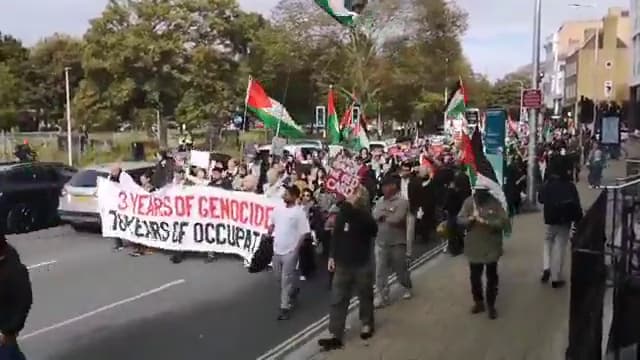
Martin said that despite a ceasefire in Gaza, the situation on the ground had not changed and Israeli attacks were continuing. He said the international community had failed on Palestine and that the only solution to decades of poverty, loss of life and tension was to create conditions in which the State of Palestine and Israel could live side by side in peace and security.
Martin also noted that there had been some positive developments. He said more states had recognized the State of Palestine, most United Nations members had signed the New York Declaration and more countries had taken steps against the illegal violence of settlers in the occupied West Bank.
Nevertheless, Martin said time was running out and alleged that some actors on the ground were taking deliberate steps to eliminate the possibility of a two-state solution.
Strong criticism of events in Gaza
Martin argued that the actions by Israel that he said were aimed at eliminating the State of Palestine could no longer be dismissed as conspiracy theories. He drew attention to people forced to shelter in buildings damaged during the war and cited the deaths of eight children after a building collapsed.
Martin also alleged that humanitarian aid, food and tents were being deliberately prevented from entering Gaza. He said that when the full truth about what happened in Gaza emerged, no one would be able to say, "I did not know."
Martin said the occupation and violence in the West Bank had reached a level that threatened the prospect of lasting peace. He alleged that Israelis continued to act with impunity after taking control of Palestinian land and said Palestinians were facing displacement, destruction and ethnic cleansing.
Martin also referred to the destruction of Palestinian villages and the devastation of agricultural land, recalling that Ireland had banned trade with Israeli settlements established on those lands.
Lebanon and United Nations reform
Martin said Israel's military presence in areas of Lebanon where Irish soldiers were serving as peacekeepers must end. He called for tensions between Iran, the United States and Israel to be resolved at the negotiating table.
Martin said the United Nations system needed to be reformed and that reforms were essential for adapting to a rapidly changing world. He said the political, financial and practical support of member states was needed for the initiatives to produce results.
Martin said a Security Council capable of using its powers to respond to crises was needed. He said the veto granted to permanent members weakened the council and raised questions about the legitimacy of the body.
He said Security Council membership should reflect today's world, starting with underrepresented Africa and small states whose voices were not being heard.
Stay Updated with Hilal Times
Subscribe to be informed about special news, developments and announcements. We will keep you informed.
By signing up, you agree to our Privacy Policy