U.S. restrictions on the legal immigration system directly affect nationals of several Arab countries who wish to move permanently to the United States.
The U.S. Department of State said that, effective January 21, 2026, the issuance of immigrant visas to nationals of 75 countries was suspended as part of a review of screening policies and procedures concerning the possibility that immigrants could rely on public assistance in the future.
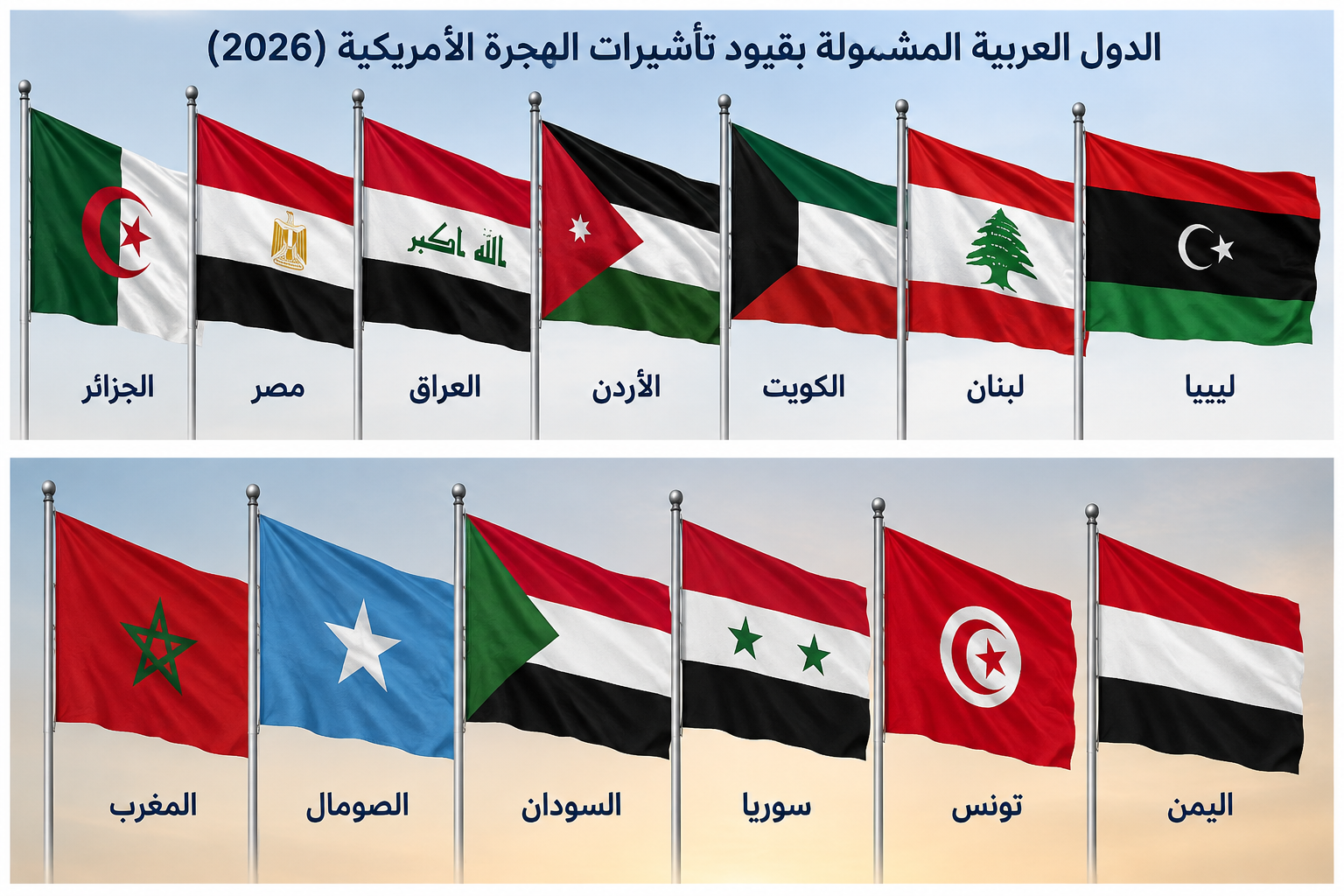
The list of affected countries includes 13 Arab countries stretching from North Africa to the Middle East.
13 Arab countries covered by the restrictions
According to the official list published by the U.S. Department of State, the Arab countries affected by the decision are:
Algeria, Egypt, Iraq, Jordan, Kuwait, Lebanon, Libya, Morocco, Somalia, Sudan, Syria, Tunisia and Yemen.
The measures are not limited to Arab countries, as the list includes 75 countries from different regions around the world.
The suspension of immigrant visa issuance comes as the U.S. administration reassesses its procedures for evaluating applicants’ ability to support themselves and the possibility that they may rely on certain forms of public assistance in the future.
Visa applications and interviews may continue
One of the key details of the decision is that the immigrant visa application process has not been halted entirely.
According to the U.S. Department of State, nationals of the countries on the list may still submit applications for immigrant visas.
U.S. embassies and consulates may also continue scheduling interviews, and applicants may attend their scheduled interviews.
However, the issuance of the immigrant visa itself is suspended for people covered by the measures.
Therefore, it would not be accurate to describe the decision as a suspension of all immigration applications, since the measure focuses primarily on the visa issuance stage.
Tourist visas are not covered by this decision
The decision concerning the 75 countries does not cover tourist visas or other visas classified as nonimmigrant visas solely because a person is a national of a country on the list.
Visitor and tourist visas, such as B1/B2 visas, are classified as nonimmigrant visas, while the current decision targets immigrant visas for people seeking to move permanently to the United States.
Accordingly, a country’s inclusion on the list of 75 does not, by itself, mean that all of its nationals are barred from applying for a U.S. tourist visa under this decision.
Nevertheless, other visa types remain subject to their own rules, security screening procedures and any other U.S. restrictions that may apply separately.
Significant effects on family-based immigration and permanent residence
Immigrant visas are one of the main channels allowing foreign nationals to move to the United States for permanent residence.
The U.S. immigration system includes multiple visa categories linked to family, employment and other pathways that qualify applicants for permanent residence.
As a result, the current restrictions may have a significant impact on people outside the United States who are trying to complete permanent immigration procedures through U.S. embassies and consulates.
However, the decision does not mean that all applications for a Green Card or adjustment of status filed from within the United States through U.S. Citizenship and Immigration Services (USCIS) have automatically stopped.
The decision concerning the 75 countries primarily relates to the issuance of immigrant visas through the Department of State and U.S. consular missions.
Washington links decision to the public charge rule
The U.S. Department of State linked the measures to a review of how the likelihood that immigrants will rely on public assistance in the future is assessed, a concept known in the U.S. immigration system as “Public Charge.”
The U.S. administration maintains that immigration applicants must demonstrate their ability to support themselves financially and avoid becoming a burden on public resources.
In this context, U.S. authorities are reviewing the policies, regulations and screening procedures used to evaluate applicants for immigrant visas.
The suspension of visa issuance for nationals of the countries on the list is part of this review.
Exceptions for dual nationals
The measures include some important exceptions.
According to the U.S. Department of State, a person may not be subject to the restrictions in some cases if they hold the nationality of a country on the list along with the nationality of another country that is not listed.
To qualify for this exception, the applicant must use a valid passport issued by the country not covered by the list when submitting the application.
There are also exceptional mechanisms in certain special cases, including some cases involving children adopted by U.S. citizens, which may be subject to individual assessments and exceptions related to the national interest.
Previously issued valid visas have not been revoked
Another important point is that the decision does not mean that all immigrant visas issued before the measures took effect have been revoked.
The U.S. Department of State clarified that valid immigrant visas already issued have not been revoked under this decision concerning the 75 countries.
Therefore, the suspension of issuance does not automatically invalidate all previously issued immigrant visas.
However, the final decision on whether to allow entry into the United States remains subject to assessment by U.S. border and immigration authorities upon arrival.
Decision affects Arab countries in North Africa and the Middle East
The list draws attention because of the large number of Arab countries included.
In North Africa, the restrictions cover Algeria, Egypt, Libya, Morocco, Sudan and Tunisia.
In the Middle East, they cover Iraq, Jordan, Kuwait, Lebanon, Syria and Yemen, in addition to Somalia, which is a member of the Arab League.
The measures are particularly significant for people seeking to move permanently to the United States through family ties or other immigration pathways from these countries.
No end date set for the restrictions
The U.S. Department of State set January 21, 2026, as the date for beginning the suspension of immigrant visa issuance, but did not set an end date for the measures.
The department says it is conducting a comprehensive review of policies, regulations and screening procedures related to the possibility that some applicants could become a “public charge” after entering the United States.
Until the review ends or the U.S. administration issues a new decision, the future of immigrant visa issuance for nationals of the affected countries will remain tied to the current policy.
According to official information available in August 2026, the suspension of immigrant visa issuance for nationals of the 75 countries remains in effect.
For nationals of the 13 affected Arab countries, the ability to submit an immigration application or attend a consular interview does not necessarily mean they can obtain a visa while its issuance remains suspended.