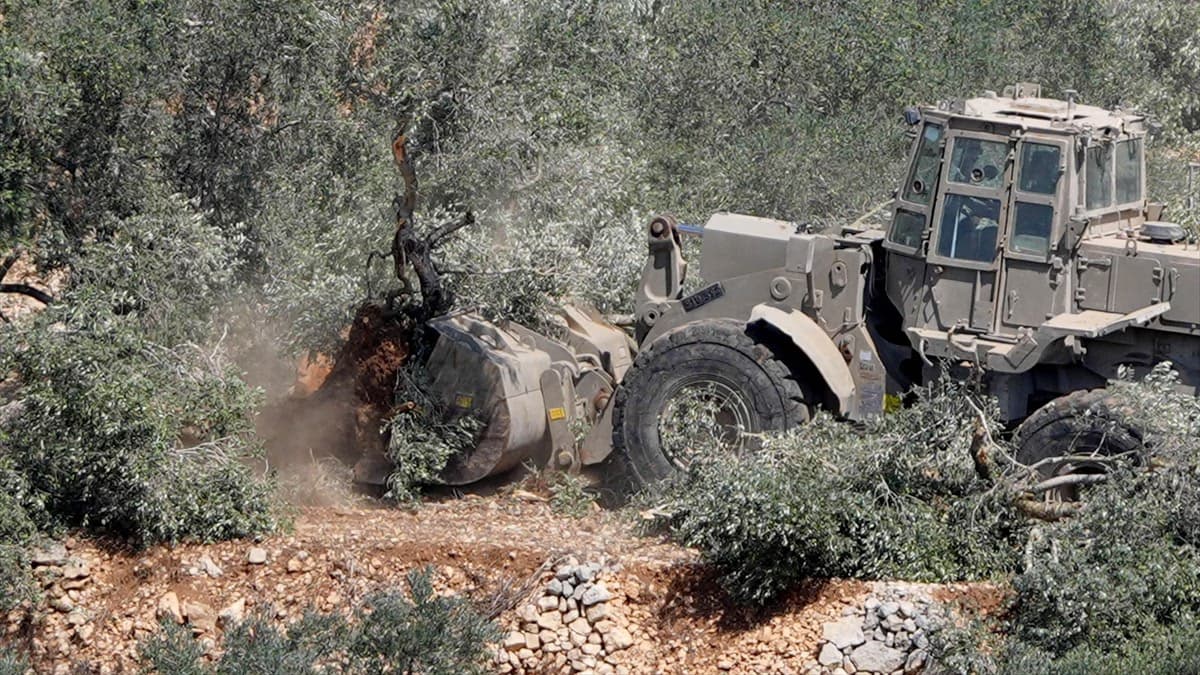
Forty-seven Palestinian families living in the Khirbet ar-Ras al-Ahmar area of the occupied West Bank have been stranded for five days after the Israeli army closed the last access route to the area.
Area resident Sair Bisharat said the dirt roads had been closed for more than two months and that access had been completely cut off after the last route was closed. Bisharat said the siege imposed on the area began to intensify about three years ago.
Trench dug across access road
According to Bisharat, a trench was dug across the road where the last access point was located five days ago. The closure of this road, which had previously been used only by animals and agricultural vehicles, left the area surrounded by trenches, walls and military zones.
Bisharat said the 47 families in Khirbet ar-Ras al-Ahmar depend on livestock farming for their livelihoods and that, in addition to basic necessities, feed needed for their sheep could no longer be brought into the area. Farmers have reportedly been forced to cross the trench under difficult conditions to take the milk they produce outside the area.
Access to 90% of grazing land restricted
Bisharat said 90% of the approximately 360,000 dunams of land used by livestock owners as grazing areas had been seized or access to it had been prohibited.
Bisharat argued that Israel’s pressure on the area, imposed by designating it as a military zone, was aimed at displacing the entire Palestinian population there. He said the closure of the access routes had directly affected the lives and livelihoods of local residents.
Attacks reported in different parts of the West Bank
A Palestinian civil society organization said various attacks targeting Palestinians and their property had taken place in different parts of the West Bank. The organization said that Wahid Taha, a man in his 50s, was beaten and exposed to pepper spray while going to a mosque in the village of Burqa, near Ramallah.
It said an attempt had been made to set fire to a house in the same village, a garbage container in front of another house had been set ablaze, and numerous homes had been pelted with stones. In Khirbet al-Marajim, near Nablus, masked and armed individuals reportedly surrounded a house.
Flocks were driven onto Palestinian-owned agricultural land in the Tayasir area near Tubas, while an agricultural shed was set on fire in Agziwa, east of the town of Yatta near Hebron. Racist slogans implying the killing of Palestinians were also written in the same area.
Water pipeline damaged, 8 Palestinians detained
The village of Adh-Dhahika in Masafer Yatta was left without water after the main water pipeline supplying it was damaged. Eight Palestinians who confronted individuals said to have attacked the village and attempted to take a flock of sheep were detained by the Israeli army.
The Fazil al-Haddar family, whose homes had been demolished two days earlier, was also attacked in the Khillet al-Hims area east of Yatta.
628 attacks recorded in August
The Council for Confronting the Separation Wall and Jewish Settlements, affiliated with the Palestine Liberation Organization, said 628 attacks against Palestinians had taken place in occupied East Jerusalem and the West Bank in August.
Attacks against Palestinians and their property in the West Bank and East Jerusalem have increased since attacks on the Gaza Strip began in October 2023. These attacks have included killings and detentions, the demolition of homes and other structures, the burning of places of worship and vehicles, the destruction of agricultural land, and preventing Palestinians from accessing their land.