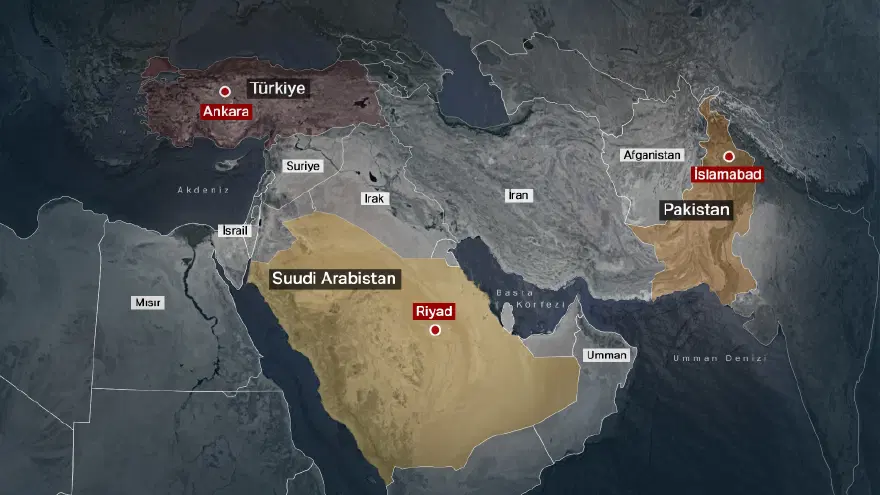
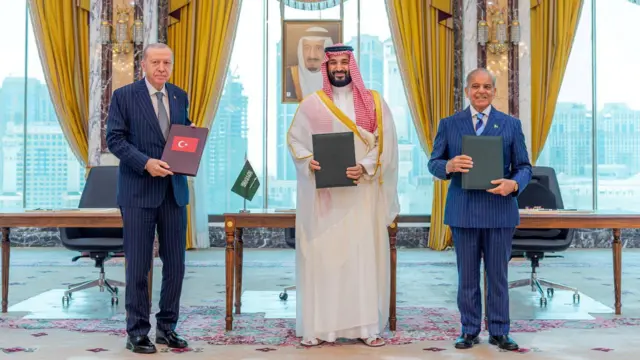
The Mecca Joint Defense Pact, signed by Türkiye, Saudi Arabia and Pakistan on August 7, has entered a new phase as details of the military and political mechanisms for implementing the agreement begin to emerge.
The framework calls for Türkiye, Saudi Arabia and Pakistan to establish high-level political and military coordination mechanisms, with the aim of turning defense cooperation between the three countries into a more institutionalized and sustainable structure.
The planned cooperation goes beyond political consultations. It includes joint military exercises involving land, air, maritime and cyber forces, as well as expanded cooperation in defense industries and military technology.
An attack on one country will be considered an attack on all three
Collective defense is one of the key elements of the Mecca Joint Defense Pact.
The agreement stipulates that any armed attack on Türkiye, Saudi Arabia or Pakistan will be considered an attack on all three countries.
This provision has prompted comparisons between the Mecca pact and Article 5 of the North Atlantic Treaty Organization, or NATO, which is based on the principle of collective defense among member states.
Turkish Foreign Minister Hakan Fidan said the principle set out in the agreement is technically similar to NATO's Article 5.
The three countries, however, emphasize that the agreement is defensive in nature and is not directed against any particular country.
Joint land, air, maritime and cyber exercises
The new details reveal the broad scope of the planned military cooperation between Türkiye, Saudi Arabia and Pakistan.
The three countries are expected to organize joint military exercises involving land, air and maritime forces, as well as cyber security and cyber operations.
The cooperation is also expected to cover modern military technologies, including unmanned systems, electronic warfare and artificial intelligence.
In the defense industry, the three countries aim to strengthen joint development and production projects as well as technology transfer.
The cooperation brings together Türkiye's growing defense industry capabilities, Pakistan's military expertise and capabilities, and Saudi Arabia's substantial economic and investment potential.
Establishing joint political and military mechanisms
The agreement also provides for the creation of institutional channels for coordination among the foreign and defense ministries and military institutions of the three countries.
Senior political and military officials are expected to hold regular meetings to assess threats and regional security developments and coordinate on defense issues.
Ankara says one of the agreement's aims is to make military and defense relations between Türkiye, Saudi Arabia and Pakistan more institutionalized and sustainable over the long term.
Will Egypt join the Mecca pact?
One of the most significant developments concerning the pact's future is the possibility that it will not remain limited to the three founding countries.
Egypt is emerging as the first country whose possible accession to the Mecca Joint Defense Pact is being seriously discussed.
Egyptian Foreign Minister Badr Abdelatty said Cairo is studying the agreement and the legal and constitutional implications that could result from joining it.
Egypt has therefore not yet made a final decision on accession.
Nevertheless, Cairo's consideration of the agreement is highly significant given Egypt's military and political weight in the Middle East and North Africa.
Türkiye supports expanding the pact
Ankara has expressed a positive position on the possibility of expanding the defense structure to include other countries in the region.
Türkiye has also shown interest in Egypt joining the cooperation between Türkiye, Saudi Arabia and Pakistan.
If Cairo decides to join in the future, the pact would bring four of the region's leading military and political powers together under a single collective defense mechanism.
This could mark a significant shift in the nature of the pact, from trilateral defense cooperation to a broader regional security framework.
Could the pact replace the United States or NATO?
The Mecca pact has sparked discussion about its potential impact on the traditional security architecture of the Middle East.
Saudi Arabia maintains extensive military and security ties with the United States, while Pakistan has important defense relations with both China and the United States. Türkiye has been a member of NATO since 1952.
Some analysts therefore believe that the creation of an independent collective defense mechanism by the three countries could reflect a regional trend toward diversifying security partnerships and reducing reliance on a single external actor.
There are currently no indications that the Mecca pact aims to replace NATO or end existing security relations with the United States.
The participating parties have emphasized that the agreement is defensive and does not constitute an alliance directed against any specific country.
Is a new security structure emerging in the region?
Just days after it was signed, the Mecca Joint Defense Pact has become the focus of growing discussion about the future of regional security.
The creation of joint political and military mechanisms, the organization of exercises on land, in the air, at sea and in cyberspace, and expanded cooperation in defense industries could give the pact greater weight than a purely political treaty.
The real test, however, will be how the collective defense provision is applied in a crisis, how effectively the three countries can coordinate their military policies, and whether other countries decide to join.
In this context, Egypt's next step will be particularly important.
If Cairo decides to join in the future, the Mecca pact could evolve from a trilateral defense mechanism between Türkiye, Saudi Arabia and Pakistan into the nucleus of a broader regional security system, potentially having a significant impact on the balance of power and alliances in the Middle East in the period ahead.