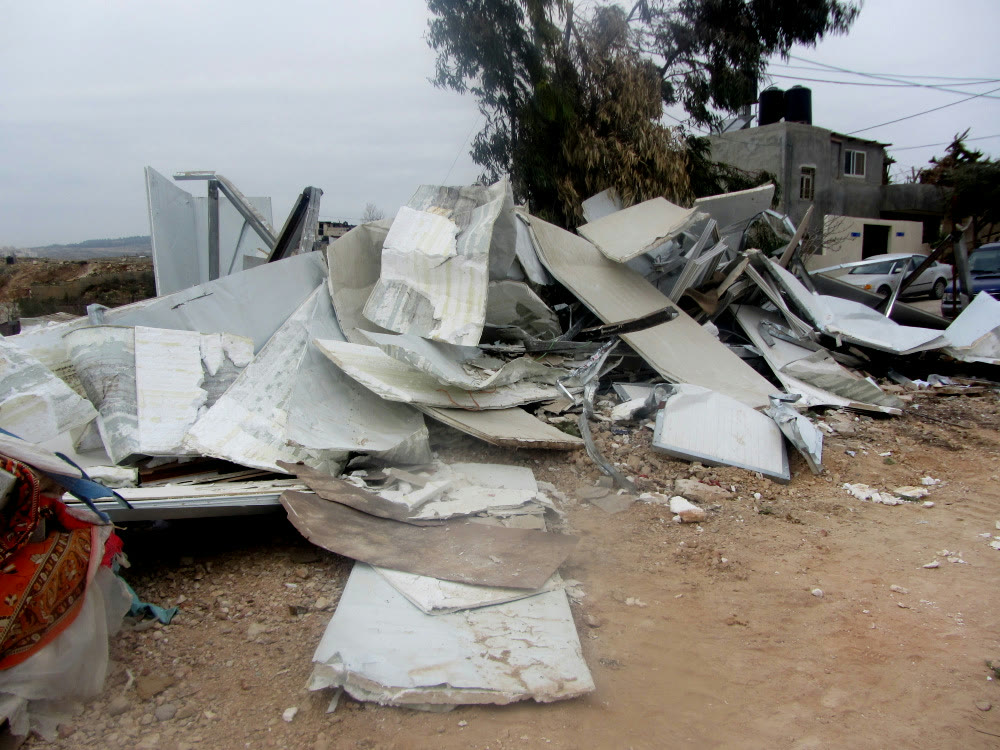
Two Palestinian families in the towns of Beit Hanina and at-Tur in East Jerusalem were forced to demolish their homes under pressure from Israeli authorities. In Beit Hanina, Fadil al-Rajabi carried out the demolition after being told that his home had been built without a permit.
In the Sheikh Anbar neighborhood of at-Tur, Muluk Kazim Abdullah also demolished her home, which had stood for 20 years. A family of 16 had lived in the 200-square-meter house.
Israeli authorities force Palestinians in East Jerusalem to demolish their own homes so they do not have to pay the high costs of demolitions carried out by municipal teams. Palestinians and human rights organizations say restrictions on obtaining building permits increase unlicensed construction and the risk of demolition.
The United Nations and the international community consider East Jerusalem occupied territory and do not recognize Israel's unilateral annexation of the city in 1980.
Forty-seven families given a deadline to leave in Tubas
Forty-seven families living in the Khirbet ar-Ras al-Ahmar area, affiliated with the city of Tubas in the northern West Bank, were given until Sunday to leave their homes and land.
Hasan Mleihat, general coordinator of the Organization for the Defense of Bedouin Rights, said residents faced an uncertain future. Mleihat said the families had been under continuous siege for 27 days and were facing increasing difficulty accessing basic necessities.
Mleihat called for the safety of civilians in the area to be ensured, property and livelihoods to be protected, the siege to be lifted and access to basic necessities to be guaranteed.
Sair Basharat, a resident of the area, said the Israeli army had closed the last passage providing access to the area in mid-September. Basharat said a trench had been dug along the only dirt track as part of a siege that had gradually intensified for about three years, adding that the area was surrounded by trenches, walls and military zones.
Basharat said 90 percent of the approximately 360,000 decares of land previously used as pasture had been seized or access to it had been banned in the area, where livestock farming is the main source of livelihood.
Seven Palestinians injured in the West Bank
A 26-year-old Palestinian was injured and taken to hospital after the Israeli army opened fire in the city of Hebron in the southern West Bank. Four Palestinians were injured and transferred to medical centers in an attack in the Jabal Qamas and az-Zahr areas south of the town of Beita.
Two Palestinians were also injured by Israeli army fire during clashes in the village of Qarawat Bani Zeid, northwest of Ramallah. The total number of Palestinians injured in these incidents thus rose to seven.
Seven farmers detained
Three farmers harvesting olives near the town of Nahalin, affiliated with Bethlehem, were detained. A farmer picking olives in the town of Beit Imrin, affiliated with Nablus, was abducted. Israelis who attacked Palestinian farmers in the town of Kaffin, affiliated with Tulkarm, also detained three more people.
According to data from the Council for Countering the Separation Wall and Jewish Settlements, Israelis seizing Palestinian land have carried out more than 14,742 attacks in the West Bank since October 2023. The attacks killed 66 Palestinians and destroyed, burned or uprooted 147,111 trees, including 100,485 olive trees.
Violations in the West Bank and East Jerusalem
Since October 2023, the West Bank and East Jerusalem have seen killings, arrests, the demolition of homes and facilities, the burning of mosques and vehicles, the destruction of farmland, the blocking of farmers' access to their land and forced displacement targeting Palestinians and their property.
According to the Council for Countering the Separation Wall and Jewish Settlements, more than 63,000 violations and attacks targeting Palestinians and their property were carried out during this period. Israel has kept the West Bank, including East Jerusalem, under occupation since 1967.
Ben-Gvir advocates expelling Palestinians
Israel's National Security Minister Itamar Ben-Gvir said he would become Israel's defense minister in the future. Ben-Gvir said that if he assumed the post, he would oversee and encourage the expulsion of Palestinians from the West Bank and Gaza.
A video created using artificial intelligence showed Palestinians in Gaza leaving notes in bottles in the sea, Ben-Gvir collecting the notes and approving migration forms, and the Palestinians leaving the area by ship.
Ben-Gvir drew attention during Israel's attacks on Gaza with statements advocating the removal of Palestinians from the area under the label of voluntary migration. He has also faced accusations of praising torture against Palestinian detainees in Israeli prisons and of being behind a discriminatory death penalty law targeting Palestinians.


















