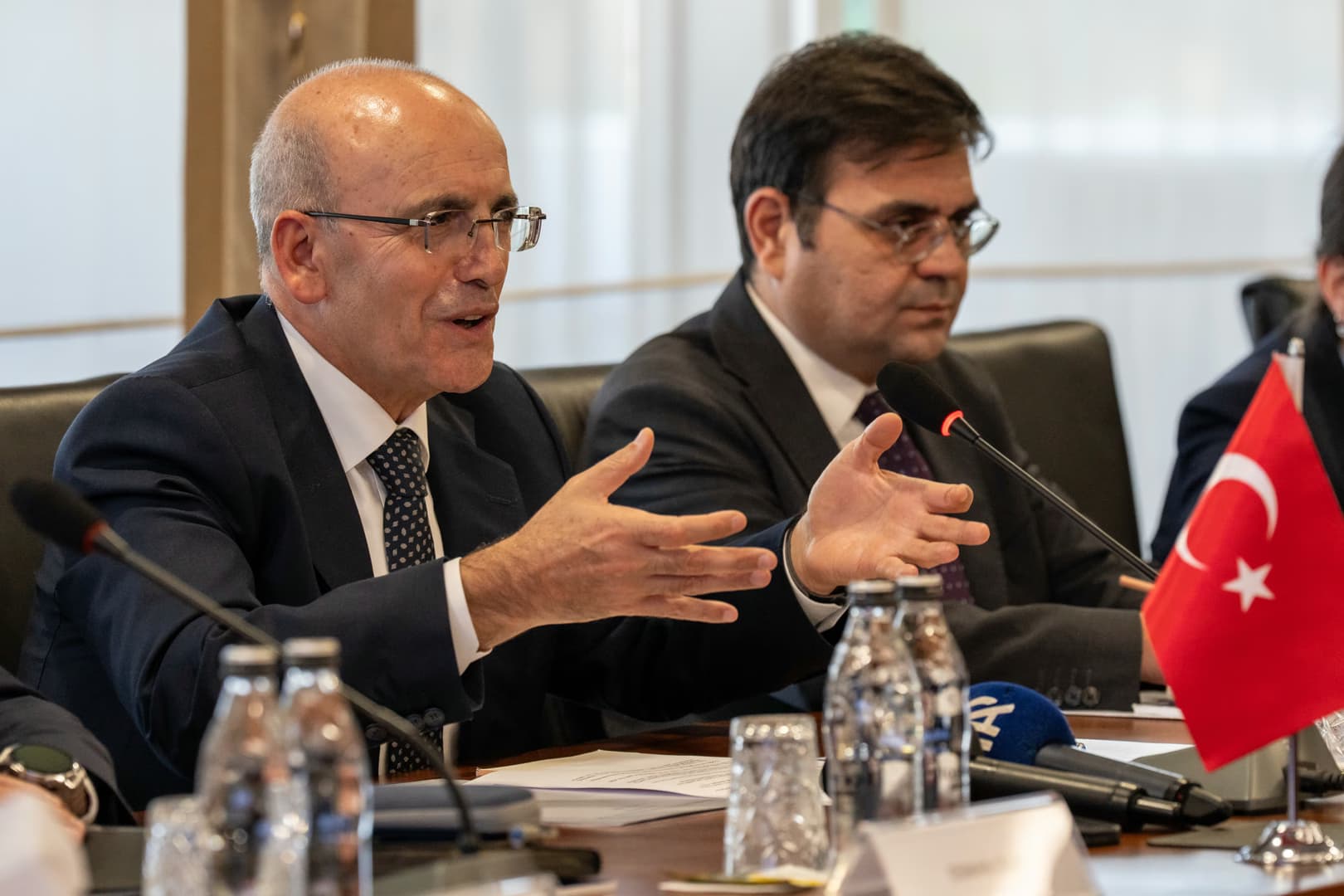
Minister of Trade Bolat received Qatar’s State Minister for Foreign Trade Ahmed bin Mohammed Al-Sayed at the ministry. Speaking after the meeting, Bolat said that, under the leadership of President Recep Tayyip Erdoğan, Türkiye was standing in solidarity with the countries of the region in response to the impact of the war that began in the Gulf on regional countries and the global economy.
Türkiye and Qatar set $5 billion trade target
Bolat said Türkiye-Qatar relations had advanced significantly over the past 21 years and that they attached great importance to the Qatari delegation’s visit. He said the annual foreign trade volume between the two countries reached $1.3 billion last year, adding that it had risen to as much as $2.5 billion in 2022 due to construction work carried out in Qatar as part of preparations for the World Cup.
Bolat said the two countries aimed to increase their trade volume to $5 billion. He added that the Türkiye-Qatar Trade and Economic Partnership Agreement, which entered into force last year, would make a significant contribution to bilateral trade.
Investment and contracting ties
Bolat said Turkish contractors had undertaken $21 billion worth of work across 206 projects in Qatar, adding that Turkish and Qatari investors were doing business with each other and establishing partnerships.
Bolat said approximately 250 Qatari companies in Türkiye had an investment volume of $7.8 billion, adding that their investments were concentrated in areas such as finance, banking, energy, logistics, broadcasting and agriculture.
Bolat said approximately 1,116 Turkish companies of various sizes were operating in Qatar, adding that they worked in construction, services and certain manufacturing sectors. He said approximately 50,000 visits took place annually in each direction between Türkiye and Qatar in the tourism sector, adding that transport ties were also in good condition.
Search for alternative routes along the Gulf corridor
Bolat said the closure of the Strait of Hormuz due to the war in the region had caused bottlenecks in logistics and supply. He said Türkiye was working to meet the demand for consumer goods in Qatar and other Gulf countries.
Bolat said alternative routes were needed to reduce dependence on maritime transport and the Strait of Hormuz. He added that, under the transit transport agreement with Saudi Arabia that took effect on April 15, Turkish carriers had been conducting intensive transit transport through Syria, Jordan and Saudi Arabia. Bolat said intensive transit transport was also being carried out along the route connecting Türkiye, Iraq, Saudi Arabia and the Gulf countries.
Bolat said they would work together to make transit and trade corridors stronger and more stable. He added that the Qatar Investment Fund wanted to make further investments in Türkiye and had taken initiatives in that direction, saying they welcomed this.
High Strategic Committee forms the backbone of relations
Bolat said Türkiye-Qatar relations continued at an almost “alliance” level in every field. He added that the meetings of the High Strategic Committee, chaired by President Recep Tayyip Erdoğan and Qatar’s Emir Sheikh Tamim bin Hamad Al Thani, formed the backbone of relations between the two countries.
Bolat said they would further develop the brotherhood and friendship between the two leaders in every field.