President Recep Tayyip Erdoğan said the Mecca Defense Agreement was not formed against any particular country, adding that it reflected the responsibility to build a safer, more peaceful and prosperous future.
Erdoğan said the agreement signed by Türkiye, Saudi Arabia and Pakistan should not be viewed as an alliance against Iran, Israel or any other country. He said the text was based on Article 51 of the United Nations Charter, which regulates the right to self-defense.
Erdoğan said an armed attack against any one of the three countries would be considered an attack against all parties. The response to an attack would be determined by taking into account the request and needs of the country targeted.
Erdoğan said intelligence, logistical and ammunition support could be provided in this context, adding that more comprehensive military support could also be considered depending on the scale of the threat. He said the method of implementation would be decided through political and military mechanisms.
Erdoğan said it was not possible to establish an automatic military scenario in advance for every development that might occur in Iraq, Yemen or elsewhere. He said Türkiye aimed to strengthen regional security, increase its deterrence capacity and support lasting stability.
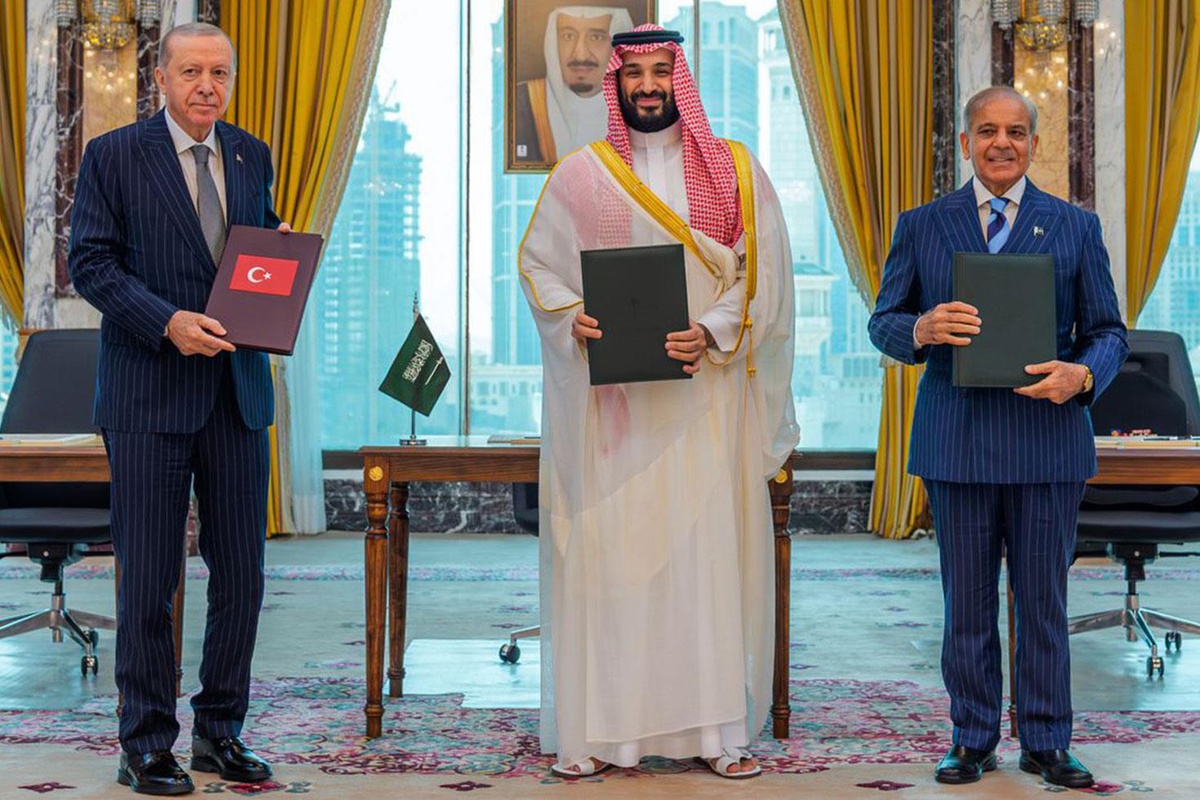
The agreement was signed in Mecca
The Mecca Defense Agreement was signed in Mecca on Aug. 7 by President Erdoğan, Saudi Crown Prince Mohammed bin Salman and Pakistani Prime Minister Shehbaz Sharif.
The agreement aims to strengthen regional and international security, peace and stability, while increasing joint deterrence in the face of growing instability.
Call to expand the scope of diplomacy
Erdoğan said the world was going through serious turbulence, noting that the Russia-Ukraine war continued to Türkiye’s north, while various conflicts continued to its south and east. He said these developments had a direct impact on the region’s security, economy and stability.
Erdoğan said expanding rather than narrowing the scope of diplomacy in such periods was a shared responsibility of the international community. He listed Türkiye’s priorities at the United Nations General Assembly as preventing conflicts from spreading to a wider geography, keeping channels of dialogue open and helping the parties return to the negotiating table.
Erdoğan said Türkiye was able to communicate with conflicting parties and launch initiatives for peace, adding that this opportunity was being used to reduce regional tensions.
Call for United Nations reform
Erdoğan said the centers of power in the world were changing and new power hubs were emerging, adding that more countries were demanding their rightful place in global decision-making mechanisms.
Erdoğan said the United Nations should not fall behind these changes and called for the Security Council to be made more representative, effective and accountable.
Erdoğan said reform of the international system could no longer be postponed, calling for an order in which the will of the General Assembly was reflected more strongly in decision-making processes and responsibilities were distributed more fairly.
Message of negotiations on U.S.-Iran tensions
Erdoğan said steps that could escalate tensions between the United States and Iran should be avoided and the parties should be brought to the negotiating table. He said a lasting solution could only be achieved in this way, adding that the United States was Türkiye’s NATO ally and Iran was its neighbor.
Erdoğan said communication channels with Iranian counterparts remained open, adding that Türkiye was using this opportunity to reduce tensions.
Erdoğan said tensions in the Strait of Hormuz directly affected energy supplies and global trade. He emphasized that the priority was to prevent the conflict from spreading, protect the security of trade routes and bring the parties back to negotiations.
Emphasis on open communication in Türkiye-U.S. relations
Erdoğan said he had a relationship with Donald Trump that enabled him to speak directly and openly, adding that the two leaders had discussed a broad agenda during their most recent meeting, including the Iran issue, regional security, Gaza and bilateral relations.
Erdoğan said open communication between leaders made it easier to manage differences and find common solutions. He said the alliance between Türkiye and the United States was multidimensional and extended back decades.
Erdoğan said cooperation in defense industry, trade and regional security could be further developed. He said Türkiye would act in a balanced manner as a sovereign state, taking into account its relations with neighbors, obligations to its allies, regional responsibilities and national interests.
Erdoğan said it was not right to define Türkiye-U.S. relations through a third country, adding that the counterpart in Washington was the U.S. administration.
Syria’s sovereignty and territorial integrity
Assessing Israel’s attacks on Syria and the defense agreement between Israel and Greece, Erdoğan said Türkiye did not base its foreign policy on inevitable war scenarios.
Erdoğan said Türkiye’s position on Syria’s sovereignty, territorial integrity and national unity was clear. He said the country’s recovery, the strengthening of state institutions and an enhanced capacity to combat terrorism would benefit the entire region.
Erdoğan said attacks that ignored international law and established rules harmed Syria’s sovereignty and made regional stability more difficult. He added that the relations Greece or any other country developed with third countries were their own choice.
Erdoğan said Türkiye was closely monitoring steps affecting its national security, legitimate rights and interests. He said the focus should be on diplomacy that would prevent such a possibility, rather than discussing in advance the consequences that a potential military conflict would have for NATO.
Erdoğan said regional security could be ensured through a structure based on alliances and partnerships that reduced tensions, strengthened deterrence and moved beyond a mutual encirclement mentality.