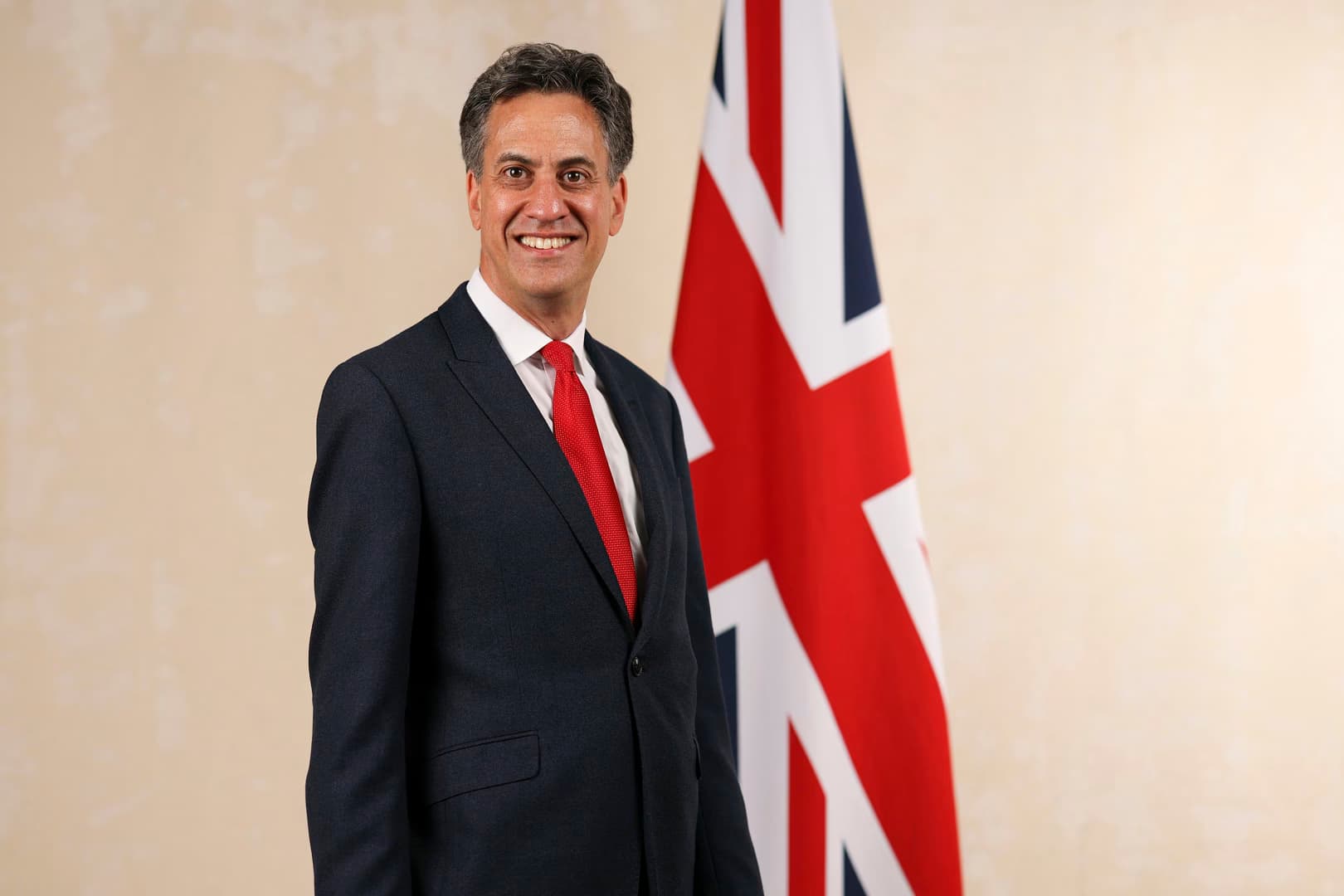
UK Foreign Secretary Ed Miliband said the Israeli government was losing friends and allies internationally because of its actions in Gaza and the West Bank.
Miliband appeared as a guest on The Rest is Politics, a podcast hosted by former minister Rory Stewart and Alastair Campbell, former Prime Minister Tony Blair’s press adviser. Defending the UK’s decision to ban trade with Israeli settlements in the occupied Palestinian territories, Miliband said he had thought for a long time about using the terms “ethnic cleansing” and “war crimes” when explaining the measure.
Miliband, who is Jewish, said he had been influenced by his mother’s views on Palestine. His mother lost 60 relatives, along with her father, in Nazi concentration camps. He said he believed she would want him to say that what Palestinians were experiencing was wrong.
Miliband said the UK wanted to strengthen its relations with Israel, but added that its goal was to demonstrate that the occupation was illegal. He said he could not say with certainty that sanctions on trade with Israeli settlements would produce results, but added that the measure could succeed if international partners took similar steps.
Call for action on Gaza’s humanitarian situation
Describing Gaza’s humanitarian situation as “indescribably terrible,” Miliband said restrictions imposed on the grounds that so-called dual-use goods could be used to make weapons were also preventing entirely innocent products from entering the region. Arguing that this policy appeared to be deliberate, Miliband announced that the UK and Jordan would hold a conference at the United Nations General Assembly next week to draw attention to the health and humanitarian situation in Gaza.
Miliband said he was frustrated by his inability to do more for Gaza and that they had launched a humanitarian aid initiative to create opportunities to deliver assistance to the region. He also said sanctions had been imposed over violations of international humanitarian law.
Miliband said Israel controlled much of Gaza and that the 20-point peace plan had not been implemented, describing the situation in the region as terrible. He argued that statements by Israeli officials did not target only armed groups but also conveyed a message of displacing Gaza’s population. He said nothing that had happened in Gaza after October 7, 2023, could be justified on any grounds.
Miliband also said that 1,200 Palestinians had been killed after the ceasefire declared in Gaza.
Emphasis on a two-state solution
Miliband said they wanted to send a message to the Israeli people ahead of elections planned for next month, adding that the international community would not remain silent as long as the occupation continued. He said they would not back down in the face of attempts to eliminate the two-state solution through settler violence and terrorism.
Arguing that Israel’s security depended on a two-state solution, Miliband claimed that Israeli Prime Minister Benjamin Netanyahu had made the country less secure, not safer. He said stability could not be achieved in the Middle East without a two-state solution and that developments in Gaza and the West Bank were causing concern around the world.
Miliband said: “The Israeli government is losing its friends. It is not gaining allies; it is losing its allies.”
Comments on the US and the Strait of Hormuz
Referring to the strained relations with the United States in recent times, Miliband said the alliance with the US remained important. He added that relations with the European Union and medium-sized countries were also important for the UK.
Describing the opening of the Strait of Hormuz as a priority diplomatic goal, Miliband said the UK needed to tackle the cost-of-living crisis. He argued that one of the main causes of the crisis was the closure of the Strait of Hormuz.
On September 8, the UK, together with 11 countries, decided to ban trade with Israeli settlements in the occupied Palestinian territories.